
New to NWSGS? You're welcome at our meetings.
Everyone is welcome to register for NWSGS meetings. For added Zoom security, we ask each registrant to have either a free Guest account or a Paid membership on file before registering.
Our Free Guest account lets you register for meetings 14 days in advance.
Paid members receive additional benefits, including 30 day advanced registration, access to speaker handouts, video replays of meeting when permitted, members-only content on our website, ability to customize some email communications, and access to our newsletter, Notes from the Northwest.
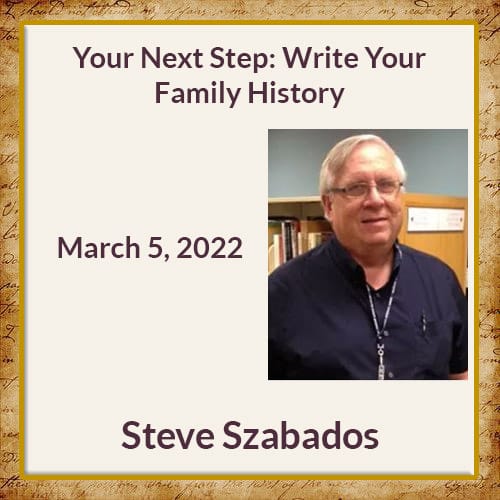
Steve Szabados — Your Next Step: Write Your Family History
Presentation Description
Were your ancestors royalty or members of the working class? Were they rich or barely surviving? Whoever they were, we need to preserve their memory. This program will discuss a process and format that makes the transformation of your research efforts to a written family history easier. Learn methods to easily save your information and tips to help your ancestors “come alive.” If we do not preserve the memories and stories of our ancestors for future generations, who will?
Meeting Summary
- Steve Szabados emphasized that a family tree is not the same as a family history, and encouraged researchers to turn names, dates, and relationships into readable stories their families can understand.
- He outlined several ways to share research, including family newsletters, self-published books, blogs, online slideshows, videos, and family websites.
- One practical approach was to begin with simple text documents such as individual summaries or quick reference sheets, then expand them into fuller narratives as more material is gathered.
- He recommended using bullet points first, then developing them into paragraphs and stories as needed, making the writing process easier and more manageable.
- Useful content to include for each ancestor can include birth, marriage, death, parents, spouse, children, immigration details, residences, occupations, schools, documents, and photographs.
- The handout encouraged adding context that brings an ancestor’s life into focus, such as migration maps, timelines, social history, county histories, newspaper articles, online images, and even street or satellite views.
- Szabados stressed the importance of documenting sources as you work, including oral history, documents, and quoted material, so facts and relationships can be reviewed and validated later.
- He also advised sharing drafts with relatives, since they may contribute additional pictures, stories, and documents that strengthen the finished family history.
Why To Watch
This replay is worth watching if you want to move beyond collecting names and dates and start turning your research into something your family will actually read. Steve Szabados offers practical, manageable ways to organize ancestor information, choose a sharing format, add meaningful historical context, and build a family history step by step. The handout adds extra value with a clear checklist of what to include and helpful ideas for making each ancestor’s story more complete.
About the Presenter
He has been researching his ancestors for about fourteen years and has traced ancestors back to 1600s New England and 1730s in Poland, Germany, Bohemia, and Slovenia. He has given numerous presentations to genealogical groups and libraries in Illinois, Indiana, and Wisconsin. His goal is to share his passion for Family History.
Steve Szabados is a genealogy speaker, author, and columnist. He received a Bachelor of Science Degree from the University of Illinois in Champaign-Urbana, Illinois, and an MBA from Northern Illinois University in DeKalb, Illinois.
He is a member of the Polish Genealogical Society of America, the Illinois State Genealogical Society, and Northwest Suburban Genealogical Society. He is also a genealogy volunteer at the Arlington Heights Illinois Library. He is the author of six print books – Basic Genealogy, Write Your Family History, Finding Grandma’s European Ancestors, Polish Genealogy, Memories of Dziadka, Quick Reference to U.S. Census Records, and Deciphering the 1790-1840 U.S. Census Records. He has also published five eBooks on genealogy. All are must-have books for the beginning genealogist looking for their European heritage. Steve is also the genealogy columnist for the Polish American Journal.