
The ABC’s and 123’s of Researching Your Ancestor’s School Records
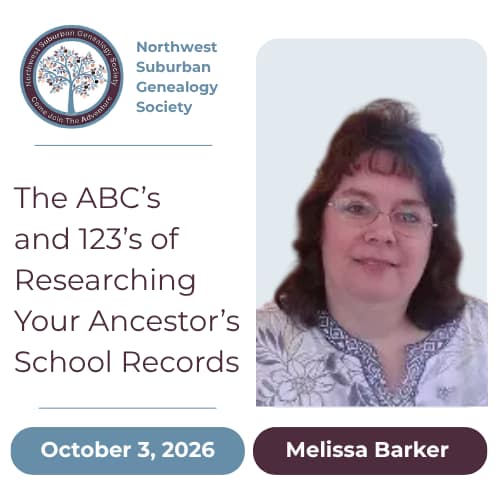
The ABC’s and 123’s of Researching Your Ancestor’s School Records The records of local public schools and universities can be valuable resources for…
finding information about your ancestors. Even if your ancestors didn't attend school, you would be surprised by what you can find in school records about them. This webinar will show you what types of school records there are and how to find them in repositories.
Melissa Barker, known as The Archive Lady, is a Certified Archives Manager, Public Historian, and professional genealogist specializing in Tennessee records.
Melissa Barker has been a professional genealogist for over two decades, with extensive experience in researching family histories and archival records, particularly in Tennessee and Kentucky. She currently serves as the Archivist and Records Manager at the Houston County, Tennessee Archives & Museum, where she has been the first and only archivist for more than 15 years. Her expertise includes historical records methodology, records preservation, and genealogical research techniques.
Contributions to Genealogy
Melissa is widely recognized in the genealogy community for her educational efforts. She conducts virtual webinars and presentations across the United States and internationally, teaching genealogists how to navigate archives, locate historical records, and preserve documents. She has presented at conferences such as the We Are Cousins Virtual Genealogy Conference, covering topics like “Breathing New Life Into Your Boring Ancestors” and using finding aids for manuscript collections.
Reconstructing World War I Army Service Records: Unraveling Ancestral Stories Through Unit Records
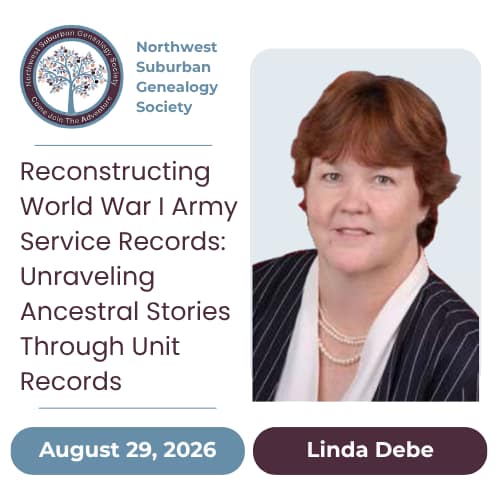
In this one-hour presentation, we delve into the fascinating world of World War I army service records and explore the invaluable role of unit records in reconstructing the…
journeys of our ancestors who served. Discover how unit records provide a rich tapestry of information, offering insights into individual experiences, battles fought, and sacrifices made during this pivotal period in history. By exploring the wealth of information contained within unit records, attendees will gain valuable insights into reconstructing World War I army service records and honoring the legacies of their military ancestors. This presentation aims to empower genealogists with the knowledge and tools needed to navigate the complexities of wartime research and preserve the stories of those who served.
Linda Debe — Genealogy Expertise and Background
Linda Debe is a professional genealogist, lecturer, and family historian with over 40 years of research experience across the Midwest, as well as in several eastern and southern U.S. states. (progenstudygroups.com) She is affectionately known as “The Sleepless Genealogist”, a title reflecting her dedication to the craft. (thesleeplessgenealogist.com)
Professional Background
Experience: Specializes in U.S. records such as land records, Minnesota Native American records, wills, probate records, vital records, and census records progenstudygroups.com.
Research Methods: Skilled in both online research and in-person archival work at major repositories progenstudygroups.com.
Technology: Microsoft Office certified in Access and Excel, using spreadsheets to analyze large datasets efficiently. (FamilySearch)
Education: Holds an Associate of Science in Electronics Systems Technologies from the U.S. Air Force.
Pension Records: You Stopped Too Soon
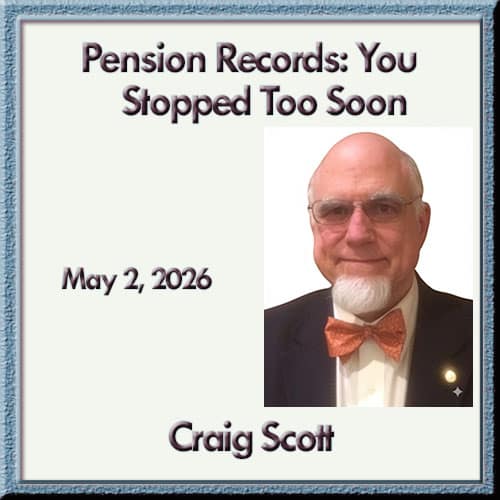
There is so much more to pension research than the pension application file. This lecture will look at pension indexes, pension law, the application files, pension ledgers,…
payments and the correspondence of the Record & Pension Office.
Craig Roberts Scott, MA, CG, FUGA is the author of The ‘Lost Pensions’: Settled Accounts of the Act of 6 April 1838 (Revised) and Records of the Accounting Officers of the Department of the Treasury, Inventory 14 (Revised). His most recent work is Understanding Revolutionary War and Invalid Pension Ledgers, 1818 – 1872, and the Payment Vouchers They Represent. He has authored seventeen books and several articles in the National Genealogical Society Quarterly, the Magazine of Virginia Genealogy, and other genealogical publications. He is the President and CEO of Heritage Books, Inc., a genealogical publishing firm with over 10,000 titles in print. A professional genealogical and historical researcher for more than thirty-nine years, he specializes in military records, problem-solving, Quakers, and publishing. He is a Company of Military Historians member and on the National Genealogical Society Quarterly editorial board. He is a former Director of the Association of Professional Genealogists. He is the Vice-President of the APG Writer’s SIG. He has coordinated research tracks at the Institute of Genealogy and Historical Research, Samford University, the Salt Lake Institute of Genealogy, and the Genealogical Research Institute of Pittsburgh. He is currently the SLIG Guided Research and Consultation Track Coordinator, helping students solve brickwall problems. He is the host of the YouTube @Just Genealogy channel. He is a recipient of the Grahame T. Smallwood, Jr. Award and the UGA Silver Tray Award. He became a Fellow of the Utah Genealogical Association in 2014.
How to Write Ancestral Stories Your Relatives Will Want to Read
Part of the thrill of genealogy is sharing our discoveries with those we love, so it can be disappointing when they have no interest in the subject. However, with good research,…
thoughtful planning, and a dash of ingenuity, we can create engaging stories designed to entice even the most reluctant readers. Topics include how to breathe life into dry genealogical facts, choosing a compelling story structure, and presenting your writing in an appealing way. Creating a captivating story from our ancestors’ names, dates, and places is like turning fish eggs into caviar: the facts don’t change, but the way we describe them makes all the difference.
She specializes in conducting extensive family history research and then turning the genealogical facts into illustrated stories that anyone can enjoy. After a 20-year career as a professional writer, Pam turned her full attention to her longtime love of genealogy. Since then, her articles have appeared in the National Genealogy Society Magazine, the Association of Professional Genealogists Quarterly, and the Federation of Genealogical Society's Forum magazine. As a national speaker, her lectures have taken her all over the United States.
Looking for European Roots
If you are ready to "cross the pond" in your research, this presentation will provide ideas of where to find records for European records on-line. Includes resources at the…
well-known sites like FamilySearch and Find My Past, and lesser-known sites.
She loves history, biography, puzzles, and a good mystery, which makes her perfectly suited to genealogy research! She belongs to several local and regional genealogy groups as well as being a member of the Genealogical Speakers Guild and a Professional Member of the Association of Professional Genealogists. Caron teaches at the Newberry Library in Chicago and at local libraries and genealogical societies for over ten years with consistently excellent feedback.
Early Migration and Settlement Patterns
Discover where a family moved into a state by using the statistical data recorded for all families. Learn to see where families were moving through the decades and use that…
knowledge to focus your research. Use the earliest records to find roads, communities, and potential neighbors, and develop a process for sweeping through the dust.
He is a semi-retired professional genealogist, author, and teacher who researches primarily in original records and manuscripts throughout the South. He enjoys sharing what he has learned over the years through Webinars, YouTube, and Institutes. Mark has published articles in APGQ, North Carolina Genealogical Society Quarterly, SPEAK!, The Longhunter, Robertson County[Tenn.] Times. and other society publications.
AI in Genealogical Research: A Practical Approach
See how AI works in real genealogy research through hands-on examples. Using the case study of Isabella Weatherford, we’ll learn how AI can help with common research tasks like…
writing research objectives, creating timelines, analyzing documents, and preparing reports. You’ll see examples of AI tools in action and learn what they do well (and not so well). Leave with practical tips and specific examples you can use in your own family history research.
Diana Elder AGⓇ, AGLTM, is a professional genealogist accredited in the Gulf South region of the United States. She is the author of Research Like a Pro: A Genealogist's Guide and co-author of Research Like a Pro with DNA: A Genealogist's Guide to Finding and Confirming Ancestors with DNA Evidence. With her daughter Nicole, Diana leads study groups and an eCourse that teaches the Research Like a Pro methodology using comprehensive video instruction and interactive learning modules.
Using FamilySearch’s Newest Full Text Options
If you haven’t used the Full-Text Search tools at FamilySearch, you are missing out on records about your ancestors. No longer in the experimental stage, it can be used on many of…
the record images on FamilySearch, saving researchers many hours of reading through records page by page to find their ancestors' names. These tips will help you determine the best way to search and how to filter the results.
Dawn Carlile is a native Oregonian, having grown up in Eugene and Springfield, OR, and has been involved in genealogy for 30 years, starting when her dad asked if she had ever thought about researching their family history. His mother was orphaned at age 12, and he knew very little about her family. Once she started looking into the family she was hooked. She is a professional genealogist, educator, and lecturer who began teaching classes for the Oregon Genealogical Society in 2008 and then began lecturing at libraries, genealogical societies, and cultural events. She enjoys teaching others how to research as much as she does doing research herself.
After You’re Gone: Future Proofing Your Genealogy Research
Have you ever considered what will happen to your years of genealogy research once you’re gone? Learn how to ensure that your hard work carries on. Through a combination of…
planning, common sense, and new technologies, we’ll review how to create an action plan for preserving your genealogy research.
Thomas is a Baby Boomer guy with a love of punk rock music but also art history who somehow “fell” into the technology industry years ago. He left a lucrative tech career to pursue his love of family history and genealogy. Technology and historical research seem like opposites, but “tech people” like Thomas are needed to guide you through the maze of options so you can find your ancestors and bring their stories to life. As a professional genealogist, he specializes in the use of technology and social media to improve genealogical research and as a means of interacting with others in the family history community.
Mysterious Codes: Passenger Manifests Letters and Numbers
What do those letters, numbers, stamps, and pencil marks mean on Immigration Passenger Manifests? Does your ancestor have the letter "D" or "X" next to their name? Do you know…
what V/L, #404, USB, Transit, CL, N.O.B, C/A, LPC, SI, NQIV, BSI, PV or C-XXXXX mean? You will learn if and when to contact the US National Archives or USCIS for more genealogical information from these codes. Plus, discover insights about your ancestors’ immigration experience based on these notations.
Christine’s interest in genealogy began in 1977 with the airing of the TV mini-series “Roots”. Her enthusiasm was piqued when she was given a typed pedigree chart, commissioned by her maternal grandfather, of their Dutch heritage from the New Netherlands in the 1650s. A native Californian, Christine is a graduate of UCLA in Political Science. She is retired and pursues her genealogy journey full time.
Opening Up Records from Closed Churches
Finding religious records of your ancestors sometimes requires a pedigree of the congregations to which they belonged, many of which don't exist today and require a scavenger hunt…
to unearth their registers! 1) Value of religious records: a. as vital records substitutes; b. social history of ancestors 2) Hierarchical and congregational models of organization 3) Examples of sleuthing for records for closed congregations.
James is a Pennsylvania German expert, has authored four books, including a just-released second edition of Trace Your German Roots Online. He also writes the weekly column/blog “Roots & Branches,” is a German Life magazine columnist, and has been part of a weeklong institute course on U.S. church records.
Deconstructing Your Family Tree: Re-evaluating the “Evidence”
When information passed on from researcher to researcher doesn't "add up," it's time to tear down the walls and rebuild anew. This methodology lecture shows how erroneous…
conclusions can sneak into our research uncontested. This lecture is pertinent especially today with so many online family trees that get cut and pasted into our own research. (Beginner to Advanced)
He was born and raised in northern Indiana surrounded by extended family always willing to tell tall tales. Intrigued by his maternal family’s claim to be kinfolk of Abraham Lincoln, and his paternal family’s stories of murder and mayhem, he took to genealogical research in 1980 to substantiate these family stories. Genealogical research as a hobby was in its infancy in the 1980s. Combing libraries, archives, cemeteries and courthouses as a teenager, Michael gained the skills needed to become a keen researcher.
No Easy Button: Using Immersion Genealogy to Understand Your Ancestors
Family history is so much more than just names, dates, and places, or boxes, lines, and charts. For 21st century genealogists, it is easy to limit our research to the documents or…
other facts we find online, or to what others tell us to be true. Learn how to take your research a step further to understand your ancestors’ lives through “immersion genealogy”—the process of discovering where they lived, worked, and worshipped, and experiencing those customs and traditions they passed down through the generations. Key resources, methodology, and tips for reaching out to relatives and repositories, and how to make the most out of a trip to your ancestor’s hometown (whether in North America or across the pond) will be discussed.
Is a freelance writer, instructor, and internationally recognized lecturer, specializing in Eastern European genealogical research, writing your family history, and using the Internet to trace female and immigrant ancestors. She grew up in Duquesne, Pennsylvania and earned a Bachelor of Science degree in Nutrition from West Virginia Wesleyan College in 1987 and a Master of Fine Arts degree in Nonfiction Writing from the University of Pittsburgh in 1997. Lisa is the author of eleven books, including The Family Tree Polish, Czech and Slovak Genealogy Guide, and the award-winning Three Slovak Women, and hundreds of magazine articles.
Pre-1837 British and Irish Research
The beginning of Civil Registration in England on 01 July 1837, together with the first national census which recorded individual names in 1841, greatly simplifies how one…
searches for information about ancestors in England. Prior to 1837, it is necessary to use different search strategies. This lecture will provide information, tips and strategies for searching in England and Ireland prior to 1837.
A native of northern England, is a professional genealogist and internationally known lecturer with 30 years’ experience, specializing in British Isles research.
Paul was raised on the West Coast of northern England. A mining engineer with a degree from the Cambourne School of Mines in Cornwall, England, he came to the U.S. in 1975 to get his graduate degree at the University of Wisconsin. He has been in the U.S. ever since, and in 2008 he became a dual citizen of both countries. In the intervening years, Paul received two graduate degrees and traveled widely throughout the world.
Researching Washington D.C. Records and Resources from Home
Learn how to effectively access key genealogical resources located in the Washington, DC area. Key repositories increasingly offer extensive online access to key genealogical…
information found in their holdings. Discussion will include the Library of Congress, the DAR, Smithsonian Libraries, the Society of Cincinnati Library, the National Archives, Bureau of Land Management, and several others. We will also highlight what is only available on site.
Richard (Rick) G. Sayre is a Certified Genealogist®, a current trustee of the Board for Certification of Genealogists and a past president of the board. His areas of genealogical expertise encompass records of the National Archives, the Bureau of Land Management, and the Daughters of the American Revolution, including military records, land records, using maps in genealogy, urban research, Irish research, and government documents.
10 Generative AI Prompts Every Genealogist Needs to Know
The “prompt” is perhaps the most important aspect of generative artificial intelligence (AI). The prompt is how we direct AI tools to give us the output we desire. However,…
forming these prompts can be challenging and is rarely a one-shot attempt. We will identify how to formulate (and reformulate!) AI prompts and look at ten example prompts that can save us significant time and effort.
He is a professional genealogist specializing in DNA evidence. In 2007 he started The Genetic Genealogist (www.thegeneticgenealogist.com), one of the earliest blogs on the topic. Blaine is the author of The Family Tree Guide to DNA Testing and Genetic Genealogy, and co-author with Debbie Parker Wayne of the award-winning Genetic Genealogy in Practice, the world’s first genetic genealogy workbook. He also co-authored “Genetics for Genealogy” with Judy Russell in 2018’s Professional Genealogy: Preparation, Practice & Standards (ProGen PPS) (Elizabeth Shown Mills, Author and Editor).
DNA in Action: Using DNA test Results to Confirm a Pedigree
Are you looking for hands-on practice with DNA? A way to apply what you have learned so far about genetic genealogy in your personal research? How about taking one of your…
ancestral lines, applying DNA analysis skills, and proving that line back to your second great- grandparents? This lecture fills the gap between our getting started with genetic genealogy and being ready for more advanced challenges.
Karen Stanbary, MA, LCSW, CG®, CGG SM, BCG Trustee, is an author and national lecturer focusing on topics related to using genetic evidence correlated with documentary evidence to solve genealogical brick walls. A Chicago local, she holds a Master’s Degree in Clinical Social Work from the University of Chicago and has completed advanced graduate study in Social Anthropology at the Colegio de Michoacán, Mexico. Her genealogical practice specializes in Midwestern U.S., Chicago, and Mexican research as well as complex problem-solving, unknown parentage, and DNA analysis. She is a coordinator and faculty member at IGHR, and SLIG. She received the NGSQ Award for Excellence for two complex evidence case studies incorporating traditional documentary research and autosomal DNA analysis in the June 2016 and June 2023 issues of the National Genealogical Society Quarterly. She published “Drowning in DNA? The Genealogical Proof Standard Tosses a Lifeline” in Debbie Parker Wayne’s book Advanced Genetic Genealogy: Techniques and Case Studies. She holds the credentials Certified Genealogist and Certified Genetic Genealogist from the Board for Certification of Genealogists where she serves as a Trustee and is chair of the DNA Committee.
Finding Our Women: 25+ Places to Find a Surname
Our female ancestors get “lost” more often than men because of their name changes. Perhaps one of the 25+ places to look may be new to you and allow you to more fully identify…
your female ancestor!
Jill Morelli, CG, CGL, loves to share her passion for genealogy with others. She is a writer, lecturer and researcher specializing in the methodology, US Midwest, and Scandinavia. Jill is the founder of the Certification Discussion Group and a co-founder of the Applied Genealogy Institute, a practicum-based educational opportunity for intermediate and advanced learners. Jill has been published in the National Genealogical Society Quarterly, Swedish American Genealogist, and many others. Jill is past president of the Seattle Genealogical Society, program director of her local chapter of the Association for Professional Genealogists and belongs to many local genealogical societies.
The Genealogical Value of German Guild Records
In this lecture, we discuss the history, structure, and purpose of guilds. Then, we look at some of the many record types that guilds created and how they can be of use to the…
researcher, especially when church records are missing and how these records can fill those gaps.
Doctor Juengling received his bachelor’s degrees in German Studies and Secondary Education at Western Oregon University, his Master’s and Doctorate in Germanic Philology with minors in both English and Linguistics at the University of Minnesota. Germanic Philology is a highly specialized field of study, combining languages, linguistics, paleography and history. For his graduate degrees, Dr. Juengling was required to demonstrate competence in English, German, Medieval Latin and two other modern languages.
Following an Evidence Trail Through 5 Countries to Find Irish Ancestors: A Case Study
Lecture 1: Following an Evidence Trail Through Five Countries to Find Irish Ancestors: A Case Study A cryptic note in Missouri and unexpected shared DNA trigger a path through…
records in the United States, Northern Ireland, Canada, New Zealand, and Ireland to identify Irish Ancestors. Lecture 2: Overcoming record destruction with Indirect Evidence, Including atDNA: A case Study This lecture explains and demonstrates, via a specific case study, how to use atDNA to strengthen weak conclusions from documentary evidence in contexts of record scarcity.
Tom has been pursuing his ancestry since 1963. For the first twenty years he was clueless about what he was trying to accomplish and how to do it. When he started climbing the genealogy learning curve he repeatedly experienced the challenges, joys, and rewards of tracing his ancestors reliably and understanding their lives. Tom eventually became an award-winning writer, board-certified genealogist, editor of the National Genealogical Society Quarterly, recipient of honors from genealogical organizations, and author of the textbooks Mastering Genealogical Proof and Mastering Genealogical Documentation. Using his nearly lifelong career in education as a springboard, including classes since 1999 online, he enjoys teaching at weeklong genealogy institutes, weekend seminars, and local, national, and international genealogy conferences, either “virtually” or in person.
Using Fold3 Library Edition
Love it or hate it, Fold3 is cornering the market on American military records online. Learn how to navigate the site, browse resources effectively, and find the hidden gems on…
this fantastic database.
Debra M. Dudek is Head of Adult and Teen Services at the Fountaindale Public Library District in Bolingbrook, IL. Ms. Dudek specializes in British genealogy, World War I research, and emerging technology topics. An alumna of Olivet College (Olivet, Michigan) and the University of Strathclyde (Glasgow, Scotland), Ms. Dudek holds a Bachelor of Arts in Journalism, a Master in Information and Library Studies, and a Post Graduate Certificate in Genealogical, Paleographic & Heraldic Studies.
Maps Galore: Finding and Using Online Maps from the Library of Congress
Maps are important resources for our genealogical research. They can place our ancestors on a particular ground at a particular time and give us clues about how they lived and…
worked. Maps can help us understand who their neighbors were and how far they had to travel for goods, services, and activities. They can allow us to go and stand on their land or in front of their houses. And maps can help us understand migration and also whether a new record we uncover really belongs to our ancestors. The Library of Congress has over 435,000 maps, of which 56,350 are currently available online. Learn what this treasure trove contains and how to find maps useful for your research.
She owns Heritage Detective, LLC, providing professional genealogical services in research, education, and writing. She speaks on a variety of genealogical topics at the national, state, and local levels and loves helping people uncover and share their family stories. She is the coordinator of the Fall Virtual Intermediate Foundations course for the Salt Lake Institute of Genealogy. Annette leads Best Practices Study Groups for a number of organizations, providing in-depth education on the genealogical research process in an interactive setting. She is president of the Association of Professional Genealogists and editor of The Florida Genealogist.
Cadastral Maps
The Austrian Cadastral Maps created in the late 1700s and mid-1800s were created for the purposes of taxation, but are a wonderful resource for genealogists today. The objectives…
of this lecture are to summarize the history of cadastral records in the Austrian Empire (also referred to as the Empire) between the late 1700s and mid-1800s with a special emphasis on areas that were once Polish but were taken over by the Austrians in the early 1770s. Also, it presents examples of documents that can be of value in genealogical research and provides hints helpful in tracking down the exact location where one’s ancestors lived.
Lucjan’s adventure with tracing family histories started in 2013 with a visit to the Diocesan Archives in Przemyśl. A friend of his showed him what old nineteenth-century vital records looked like and what information they contained. Gradually he became more and more accustomed to various kinds of longhand and was able to maximize the results of his work while minimizing the time needed to complete it. Now, genealogy research is his full-time occupation and he is honored to have discovered the roots of many.
Introduction to GEDmatch
This presentation on GEDmatch will address three distinct areas: (1) Setting up and configuring your GEDmatch account for use, (2) a review of the purpose/use of the many free…
tools, and (3) a practical example of the use of GEDmatch to further your research discoveries. This talk is geared towards those new to GEDmatch or those who have uploaded their DNA data but might have felt intimidated to do more.
John’s interest in DNA began many years ago when he started wondering if his father was an only child (like he was). Digging out some old records from his “aunt”, John quickly jumped on the DNA bandwagon with an Ancestry autosomal DNA test, quickly followed by a Family Tree YDNA test. Mostly self-taught, John enjoys sharing information to enable others to jump-start their genealogy research. John is a 20-year US Air Force veteran and currently works for Boeing. He and his wife Darlene live in Shalimar Florida.
Early Records of New England, Where to Find, What’s Available, How to Navigate
This session will cover the early records of New England, including vital records, probate, deeds, town records, and a variety of local sources that are often underutilized.…
You’ll also learn how to locate published and online resources, as well as manuscripts. Discover how to navigate and utilize the best resources available for the hidden treasures that New England records have to offer!
David Allen Lambert, Chief Genealogist has been on the staff of American Ancestors/NEHGS since 1993 and is an internationally recognized speaker on the topics of genealogy and history. He has authored many articles in the New England Historical and Genealogical Register, the New Hampshire Genealogical Record, Rhode Island Roots, Mayflower Descendant, and American Ancestors magazine; and is the author of eleven books including A Guide to Massachusetts Cemeteries and Vital Records of Stoughton, Massachusetts, to the end of the year 1850.
Digging Pennsylvania Roots from Your Desktop
It’s estimated that one in four Americans has Keystone State roots. Much of Pennsylvania research – from church records to land documents to courthouse filings – can be done…
remotely. Learn to get much of your genealogy done without setting foot in Pennsylvania.
Interim Executive Director for the Genealogical Society of Pennsylvania, is the author of four commercially published genealogy books as well as writing “Roots & Branches,” an award-winning weekly blog/newspaper column on genealogy. He is also a columnist for German Life magazine and is editor emeritus of Der Kurier, the quarterly journal of the Mid-Atlantic Germanic Society.
Researching Chicago Ancestors from Afar
Did your native and immigrant ancestors settle in Chicago, but you live in another location? Metropolitan areas can present a different set of research challenges. Learn how to…
find both traditional and unusual resources, including free and low-cost alternatives for Cook County vital records, searching Chicago newspapers, essential print and online resources, and finding immigrant and ethnic ancestors in Cook County.
After a long professional career in academic archives and genealogy libraries, Nancy E. Loe, MA, MLS, is now a genealogy educator, researcher, and writer. She specializes in U.S. and European research and provides expert guidance on information management and research skills.
Her website, sassyjanegenealogy.com offers a blog, a free monthly newsletter, and e-books on genealogy research.
Your Next Step: Write Your Family History
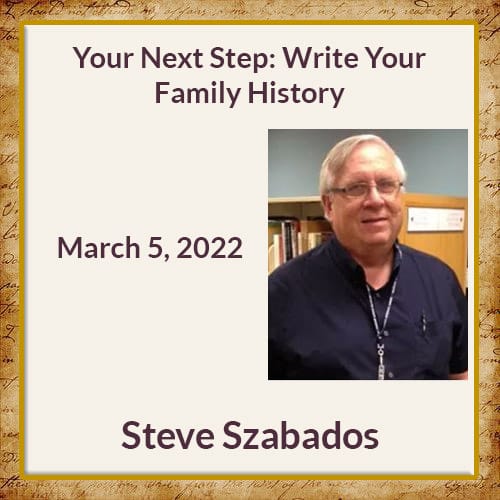
Were your ancestors royalty or members of the working class? Were they rich or barely surviving? Whoever they were, we need to preserve their memory. This program will discuss a…
process and format that makes the transformation of your research efforts to a written family history easier. Learn methods to easily save your information and tips to help your ancestors “come alive.” If we do not preserve the memories and stories of our ancestors for future generations, who will?
He has been researching his ancestors for about fourteen years and has traced ancestors back to 1600s New England and 1730s in Poland, Germany, Bohemia, and Slovenia. He has given numerous presentations to genealogical groups and libraries in Illinois, Indiana, and Wisconsin. His goal is to share his passion for Family History.
Steve Szabados is a genealogy speaker, author, and columnist. He received a Bachelor of Science Degree from the University of Illinois in Champaign-Urbana, Illinois, and an MBA from Northern Illinois University in DeKalb, Illinois.
He is a member of the Polish Genealogical Society of America, the Illinois State Genealogical Society, and Northwest Suburban Genealogical Society. He is also a genealogy volunteer at the Arlington Heights Illinois Library. He is the author of six print books – Basic Genealogy, Write Your Family History, Finding Grandma’s European Ancestors, Polish Genealogy, Memories of Dziadka, Quick Reference to U.S. Census Records, and Deciphering the 1790-1840 U.S. Census Records. He has also published five eBooks on genealogy. All are must-have books for the beginning genealogist looking for their European heritage. Steve is also the genealogy columnist for the Polish American Journal.
Mining for Genealogical Treasures in the Internet Archive
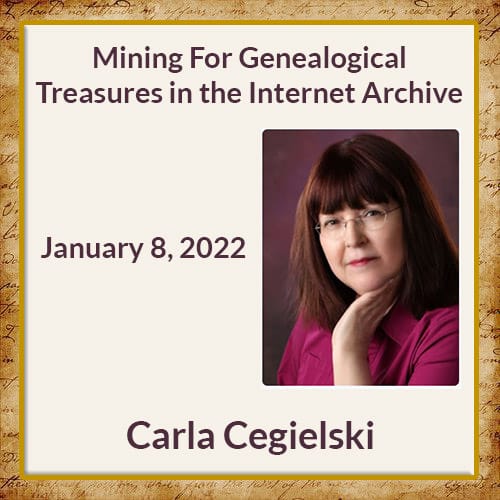
The Internet Archive is not just the Wayback Machine! It also contains audio, movies, images, software, maps, and texts. Discover everything you can do at the Archive and learn…
search strategies for accessing its genealogical treasures.
Carla Cegielski is a full-time family history researcher specializing in Ohio, Western Pennsylvania, and West Virginia research. She has been providing professional research services to attorneys, historians, genealogists, hobbyists, and others since 2007.