
New to NWSGS? You're welcome at our meetings.
Everyone is welcome to register for NWSGS meetings. For added Zoom security, we ask each registrant to have either a free Guest account or a Paid membership on file before registering.
Our Free Guest account lets you register for meetings 14 days in advance.
Paid members receive additional benefits, including 30 day advanced registration, access to speaker handouts, video replays of meeting when permitted, members-only content on our website, ability to customize some email communications, and access to our newsletter, Notes from the Northwest.
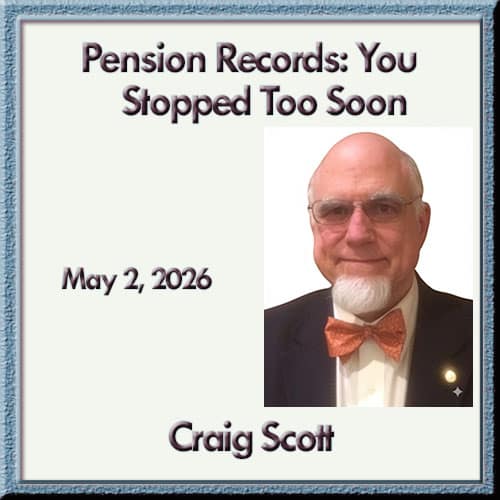
Craig Scott — Pension Records: You Stopped Too Soon
Presentation Description
There is so much more to pension research than the pension application file. This lecture will look at pension indexes, pension law, the application files, pension ledgers, payments and the correspondence of the Record & Pension Office.
Meeting Summary
May 2, 2026 Meeting Highlights
- Members discussed researching the wartime home front, including memoirs, diaries, and local or county-level publications that may describe daily life, support work, food shortages, farm responsibilities, and community conditions during wartime.
- Craig Scott suggested searching resources such as Google Books and Amazon for home-front publications, especially for World War I and World War II, where county and state publications are more common.
- The group noted that colonial-era records may sometimes be found in foreign repositories, including British archives and libraries, especially when official reports or correspondence made their way overseas.
- Members discussed the value of published ledgers, journals, rosters, and archival transcriptions for Virginia, North Carolina, colonial, and Revolutionary War research. These sources can help place ancestors, associates, and FAN club members in a specific time and place.
- Craig emphasized that colonial research often requires a different mindset: researchers may need to follow land grants, appropriations, payments, military service, and other government actions to understand where records may have been created.
- The discussion also touched on difficult research involving indentured servants, enslaved people, and Native American slavery, with suggestions to look beyond standard government records into plantation records, personal papers, tax lists, and laws that changed by time and place.
Craig Scott — “Pension Records: You Stopped Too Soon”
Craig Scott’s presentation encouraged researchers to look far beyond the pension application file. While the application itself can be rich with genealogical clues, Craig showed that pension research also includes pension law, indexes, payment ledgers, vouchers, last and final payments, settled accounts, and correspondence from the pension office.
A major takeaway was that pensions existed because of specific laws, and those laws determined who qualified, what proof was required, and where the records may now be found. Craig explained the importance of watching for “Act of” dates, understanding the differences between federal, state, and local pensions, and knowing that invalid, widow, minor, service, half-pay, and special-act pensions may each lead researchers to different records.
Craig also showed how pension-related records can reveal much more than military service. Payment ledgers and pension agency transfers may help track when an ancestor moved. Supporting affidavits, proof of identity documents, Bible records, marriage evidence, witness statements, and final payment records may identify relatives, neighbors, dates of death, marriages, and other details that are easy to miss if researchers stop after reading only the application file.
Why To Watch
Why Watch the Replay
Craig Scott’s presentation is especially valuable for anyone who has found a military pension file and wondered whether there might be more to the story. He gives researchers a practical roadmap for finding the records that surround the pension application and explains why those records can hold important family history clues.
- Learn why the pension application file is only one part of the research trail, and why stopping there may cause you to miss ledgers, vouchers, correspondence, and final payment records.
- Understand how pension laws shaped eligibility, proof requirements, and record creation, including why an “Act of” date can point you toward important historical and legal context.
- See how pension payment ledgers can help track an ancestor’s movement from one place to another, sometimes narrowing a move to a six- or twelve-month window.
- Discover how supporting pension documents may contain marriage evidence, Bible records, affidavits, death dates, witness names, and other clues that connect family members and neighbors.
- Gain a better understanding of where pension-related records may be located, including Fold3, Ancestry indexes, the National Archives, state archives, county courts, and specialized finding aids.
- Pick up research strategies for Revolutionary War, War of 1812, Indian War, Mexican War, and Civil War pension records, including how different conflicts and pension types may require different search approaches.
About the Presenter
Craig Roberts Scott, MA, CG, FUGA is the author of The ‘Lost Pensions’: Settled Accounts of the Act of 6 April 1838 (Revised) and Records of the Accounting Officers of the Department of the Treasury, Inventory 14 (Revised). His most recent work is Understanding Revolutionary War and Invalid Pension Ledgers, 1818 – 1872, and the Payment Vouchers They Represent. He has authored seventeen books and several articles in the National Genealogical Society Quarterly, the Magazine of Virginia Genealogy, and other genealogical publications. He is the President and CEO of Heritage Books, Inc., a genealogical publishing firm with over 10,000 titles in print. A professional genealogical and historical researcher for more than thirty-nine years, he specializes in military records, problem-solving, Quakers, and publishing. He is a Company of Military Historians member and on the National Genealogical Society Quarterly editorial board. He is a former Director of the Association of Professional Genealogists. He is the Vice-President of the APG Writer’s SIG. He has coordinated research tracks at the Institute of Genealogy and Historical Research, Samford University, the Salt Lake Institute of Genealogy, and the Genealogical Research Institute of Pittsburgh. He is currently the SLIG Guided Research and Consultation Track Coordinator, helping students solve brickwall problems. He is the host of the YouTube @Just Genealogy channel. He is a recipient of the Grahame T. Smallwood, Jr. Award and the UGA Silver Tray Award. He became a Fellow of the Utah Genealogical Association in 2014.