
New to NWSGS? You're welcome at our meetings.
Everyone is welcome to register for NWSGS meetings. For added Zoom security, we ask each registrant to have either a free Guest account or a Paid membership on file before registering.
Our Free Guest account lets you register for meetings 14 days in advance.
Paid members receive additional benefits, including 30 day advanced registration, access to speaker handouts, video replays of meeting when permitted, members-only content on our website, ability to customize some email communications, and access to our newsletter, Notes from the Northwest.
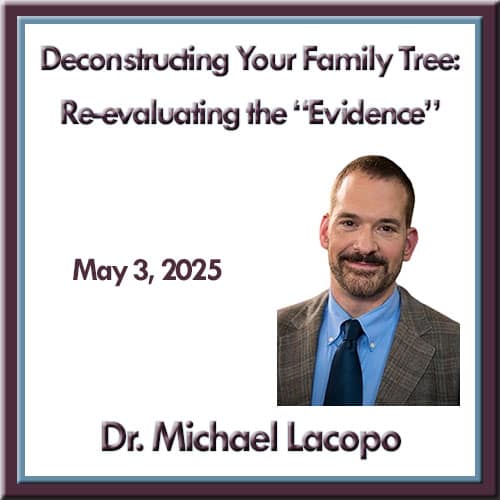
Dr. Michael Lacopo — Deconstructing Your Family Tree: Re-evaluating the “Evidence”
Presentation Description
When information passed on from researcher to researcher doesn't "add up," it's time to tear down the walls and rebuild anew. This methodology lecture shows how erroneous conclusions can sneak into our research uncontested. This lecture is pertinent especially today with so many online family trees that get cut and pasted into our own research. (Beginner to Advanced)
Meeting Summary
- Members Helping Members: The discussion included help with a Chicago-area cemetery question, suggestions for using local ethnic genealogy groups, manuscript collections, Internet Archive, DNA, and past NWSGS handouts, plus ideas for digitizing old slides and sharing family materials with relatives.
- Dr. Michael Lacopo’s main message was that genealogists need to re-evaluate accepted “facts” and ask how reliable the evidence really is before copying conclusions into their own research.
- He stressed the importance of the Genealogical Proof Standard, especially doing reasonably exhaustive research, citing sources carefully, analyzing and correlating records, and resolving conflicting evidence before reaching conclusions.
- A major takeaway was that facts and evidence are not the same thing. A recorded fact may still be wrong, incomplete, copied from a weak source, or based on a mistaken assumption.
- Using case studies, he showed how research can go wrong through clerical errors, intentional deception, innocent mistakes, fraudulent genealogy, and poor cut-and-paste research.
- He encouraged researchers to use big-picture thinking, including social history, family context, biology, timing, and geography, to decide whether a conclusion is actually logical.
- Another strong point was to follow the paper trail backward, get as close to original records as possible, and question long-accepted information if the evidence behind it is weak.
- The handout adds extra member value because it clearly outlines the proof standard, explains the major ways errors enter family trees, and provides a practical list of research habits members can apply to almost any genealogy problem.
Why To Watch
This replay is worth watching if you want to become a sharper, more confident genealogist instead of just collecting names and dates. Dr. Lacopo gives practical ways to test whether your conclusions really hold up, especially when older research, online trees, or repeated family claims may be wrong. The handout is especially helpful because it turns the lecture into a usable checklist for evaluating evidence in your own work.
About the Presenter
He was born and raised in northern Indiana surrounded by extended family always willing to tell tall tales. Intrigued by his maternal family’s claim to be kinfolk of Abraham Lincoln, and his paternal family’s stories of murder and mayhem, he took to genealogical research in 1980 to substantiate these family stories. Genealogical research as a hobby was in its infancy in the 1980s. Combing libraries, archives, cemeteries and courthouses as a teenager, Michael gained the skills needed to become a keen researcher.