
New to NWSGS? You're welcome at our meetings.
Everyone is welcome to register for NWSGS meetings. For added Zoom security, we ask each registrant to have either a free Guest account or a Paid membership on file before registering.
Our Free Guest account lets you register for meetings 14 days in advance.
Paid members receive additional benefits, including 30 day advanced registration, access to speaker handouts, video replays of meeting when permitted, members-only content on our website, ability to customize some email communications, and access to our newsletter, Notes from the Northwest.
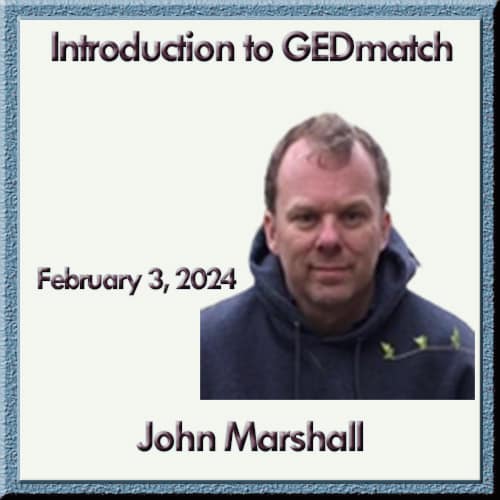
John Marshall — Introduction to GEDmatch
Presentation Description
This presentation on GEDmatch will address three distinct areas: (1) Setting up and configuring your GEDmatch account for use, (2) a review of the purpose/use of the many free tools, and (3) a practical example of the use of GEDmatch to further your research discoveries. This talk is geared towards those new to GEDmatch or those who have uploaded their DNA data but might have felt intimidated to do more.
Meeting Summary
- Members Helping Members: The discussion included an Irish gravestone naming question, German brick-wall research in Würzburg-area records, using member surname lists and research clubs, the value of Polish cadastral maps for locating ancestral land and living relatives, early RootsTech match notifications, and a short demonstration of AI chatbots as idea-generators for genealogy research questions.
- John Marshall explained that GEDmatch is not a DNA testing company, but a shared database where researchers can upload results from multiple testing platforms and compare matches across companies.
- A major takeaway was the practical setup process: create a free account, receive a GEDmatch kit number, download your raw DNA file from your testing company, upload the zipped file to GEDmatch, and wait about 24 hours for most tools to become available.
- He stressed that users should think carefully about privacy settings, including whether a kit is opt-in or opt-out for law-enforcement access, or whether it should be kept private or for research use only.
- The session highlighted the most useful free tools, especially one-to-many for finding large match lists and one-to-one for confirming whether two specific kits actually share DNA segments.
- John showed that GEDmatch becomes more valuable when researchers understand how to use kit numbers, shared matches, centimorgans, chromosome comparisons, and visualization options to sort and interpret results.
- Another important point was that GEDmatch can connect DNA work with family trees by allowing users to upload a GEDCOM, making it easier to identify which matches have trees attached and to compare both DNA and pedigree information.
- The handout adds extra member value because it gives a simple getting-started workflow, labels the major GEDmatch menu areas, and illustrates visualization options, making the site easier to navigate after the meeting.
Why To Watch
This replay is worth watching if GEDmatch has felt confusing or intimidating and you want a solid beginner-friendly introduction. John breaks the site into practical steps, explains what the main tools actually do, and shows how GEDmatch can help you compare DNA matches across testing companies instead of staying inside just one platform. The handout is especially useful because it gives you a simple visual guide you can follow while learning the site.
About the Presenter
John’s interest in DNA began many years ago when he started wondering if his father was an only child (like he was). Digging out some old records from his “aunt”, John quickly jumped on the DNA bandwagon with an Ancestry autosomal DNA test, quickly followed by a Family Tree YDNA test. Mostly self-taught, John enjoys sharing information to enable others to jump-start their genealogy research. John is a 20-year US Air Force veteran and currently works for Boeing. He and his wife Darlene live in Shalimar Florida.