
New to NWSGS? You're welcome at our meetings.
Everyone is welcome to register for NWSGS meetings. For added Zoom security, we ask each registrant to have either a free Guest account or a Paid membership on file before registering.
Our Free Guest account lets you register for meetings 14 days in advance.
Paid members receive additional benefits, including 30 day advanced registration, access to speaker handouts, video replays of meeting when permitted, members-only content on our website, ability to customize some email communications, and access to our newsletter, Notes from the Northwest.
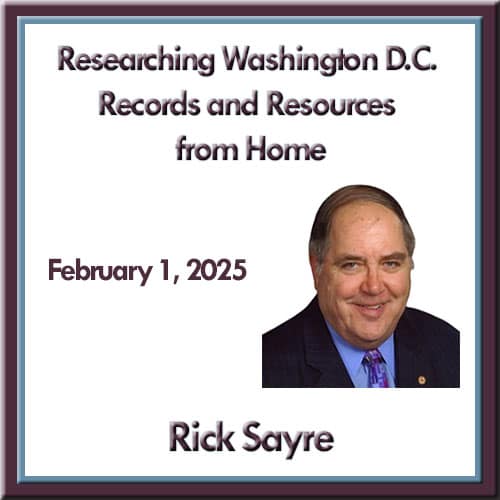
Rick Sayre — Researching Washington D.C. Records and Resources from Home
Presentation Description
Learn how to effectively access key genealogical resources located in the Washington, DC area. Key repositories increasingly offer extensive online access to key genealogical information found in their holdings. Discussion will include the Library of Congress, the DAR, Smithsonian Libraries, the Society of Cincinnati Library, the National Archives, Bureau of Land Management, and several others. We will also highlight what is only available on site.
Meeting Summary
- Members Helping Members: The discussion covered practical digitizing and preservation topics, including CZUR scanners, OCR, adding metadata to files, organizing digital images, choosing storage options, backing up research, and ideas for preserving audio, video, and family history materials before they are lost.
- Rick Sayre emphasized that Washington, D.C. repositories offer an enormous amount of genealogy material online, but successful research starts with a clear question and a research plan, not just random searching.
- A major takeaway was to learn how each repository works before diving in. He showed that the National Archives, Library of Congress, DAR, and General Land Office each have different websites, catalogs, finding aids, and digitized collections.
- He highlighted the National Archives as a key resource for federal records, with millions of images online, valuable blogs and learning tools, and important records that still require onsite research, especially for military and land files.
- The Library of Congress was presented as much more than a book library, with useful digital collections in maps, photographs, manuscripts, newspapers, sound recordings, and family histories, while also holding many more items available only onsite.
- Rick pointed out that the DAR General Research System can help researchers search ancestor, member, and descendant applications, while the DAR library also holds Genealogical Records Committee reports, special collections, and other material worth consulting.
- He showed why the General Land Office website is especially valuable for land research, giving access to land patents, survey plats, field notes, tract books, and warrants, while reminding researchers that the best supporting paperwork often still lives at NARA.
- The handout adds strong member value because it identifies the major Washington-area repositories, explains what kinds of records can be searched from home, and lists additional learning resources for going deeper into maps, military records, land files, government documents, and repository websites.
Why To Watch
This replay is worth watching if you want a better roadmap for using Washington, D.C. resources without feeling overwhelmed. Rick does a strong job of showing which repositories matter, what kinds of records each one holds, and how to approach them more strategically from home before planning any onsite work. The handout is especially helpful because it organizes the key repositories and points to additional tools for deeper research.
About the Presenter
Richard (Rick) G. Sayre is a Certified Genealogist®, a current trustee of the Board for Certification of Genealogists and a past president of the board. His areas of genealogical expertise encompass records of the National Archives, the Bureau of Land Management, and the Daughters of the American Revolution, including military records, land records, using maps in genealogy, urban research, Irish research, and government documents.