
New to NWSGS? You're welcome at our meetings.
Everyone is welcome to register for NWSGS meetings. For added Zoom security, we ask each registrant to have either a free Guest account or a Paid membership on file before registering.
Our Free Guest account lets you register for meetings 14 days in advance.
Paid members receive additional benefits, including 30 day advanced registration, access to speaker handouts, video replays of meeting when permitted, members-only content on our website, ability to customize some email communications, and access to our newsletter, Notes from the Northwest.
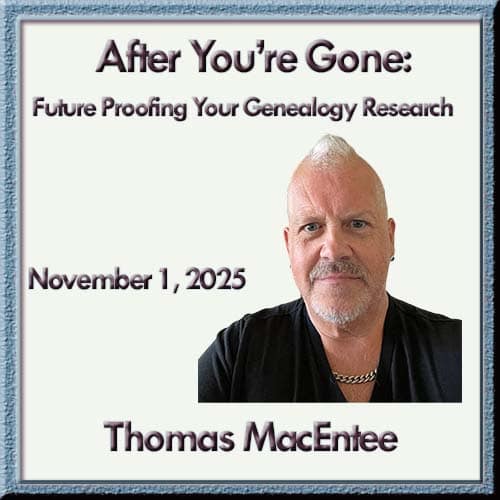
Thomas MacEntee — After You’re Gone: Future Proofing Your Genealogy Research
Presentation Description
Have you ever considered what will happen to your years of genealogy research once you’re gone? Learn how to ensure that your hard work carries on. Through a combination of planning, common sense, and new technologies, we’ll review how to create an action plan for preserving your genealogy research.
Meeting Summary
- Members Helping Members: The discussion included evaluating undocumented online findings, ideas for locating German church records, using past NWSGS handouts and meeting searches, and creative ways to use AI for research questions, writing, genealogy planning, and even organizing family history projects.
- Thomas MacEntee focused on a practical problem every genealogist faces: what happens to years of research, documents, photos, files, and family stories if no clear plan is left behind.
- A major takeaway was to create a full inventory of genealogy materials, including binders, paper files, books, photos, slides, negatives, videos, flash drives, database files, scanned items, blog posts, emails, and social media content.
- He emphasized that digital preservation matters just as much as paper preservation, including making two backups, keeping files organized, and moving aging media such as CD-ROMs, DVDs, negatives, and old video formats into safer digital storage.
- The session also covered online genealogy accounts, with the reminder to record website names, URLs, and login details and to designate legacy contacts where available so others can manage or preserve accounts later.
- Thomas explained that donating research is possible, but it requires planning. Researchers should contact libraries, archives, or genealogical societies in advance, choose organizations that are a good fit, inform family members, and understand that processing donations often requires time and money.
- He encouraged members not to wait until everything feels “finished,” but to begin preserving, labeling, sharing, donating, and documenting now so research is not lost or discarded by people who do not understand its value.
- The handout adds strong member value because it lays out a clear action plan, best practices checklist, donation guidance, and a useful list of preservation tools, repositories, articles, and digital resource links for taking the next steps.
Why To Watch
This replay is worth watching if you want a realistic plan for protecting your genealogy work instead of leaving it to chance. Thomas turns a difficult topic into practical steps you can actually follow, from organizing and backing up files to planning for legacy contacts, estate instructions, and possible donations. The handout is especially useful because it gives you a workable checklist and resource list you can use right away.
About the Presenter
Thomas is a Baby Boomer guy with a love of punk rock music but also art history who somehow “fell” into the technology industry years ago. He left a lucrative tech career to pursue his love of family history and genealogy. Technology and historical research seem like opposites, but “tech people” like Thomas are needed to guide you through the maze of options so you can find your ancestors and bring their stories to life. As a professional genealogist, he specializes in the use of technology and social media to improve genealogical research and as a means of interacting with others in the family history community.