
New to NWSGS? You're welcome at our meetings.
Everyone is welcome to register for NWSGS meetings. For added Zoom security, we ask each registrant to have either a free Guest account or a Paid membership on file before registering.
Our Free Guest account lets you register for meetings 14 days in advance.
Paid members receive additional benefits, including 30 day advanced registration, access to speaker handouts, video replays of meeting when permitted, members-only content on our website, ability to customize some email communications, and access to our newsletter, Notes from the Northwest.
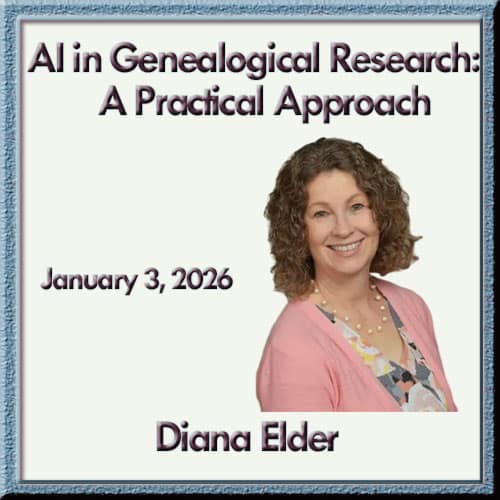
Diana Elder — AI in Genealogical Research: A Practical Approach
Presentation Description
See how AI works in real genealogy research through hands-on examples. Using the case study of Isabella Weatherford, we’ll learn how AI can help with common research tasks like writing research objectives, creating timelines, analyzing documents, and preparing reports. You’ll see examples of AI tools in action and learn what they do well (and not so well). Leave with practical tips and specific examples you can use in your own family history research.
Meeting Summary
- Members Helping Members: Howard showed how NWSGS members can use the new RootsTech search tool to find sessions by surname, place, or topic more easily than searching the RootsTech site directly, making it a practical shortcut for planning conference viewing.
- Featured Speaker: Diana Elder framed AI as a research assistant, not a replacement for sound genealogy. Her central message was to use AI to enhance traditional methods while still verifying facts and maintaining high research standards.
- She introduced several helpful AI roles for genealogists, including AI as a co-worker, tutor, coach, and creative partner, while stressing that the researcher remains responsible for judgment, proof, and correlation.
- The handout adds extra member value by listing a practical toolkit for genealogy work, including ChatGPT, Claude, Gemini, Google AI Studio, NotebookLM, and Perplexity, with notes on what each does especially well.
- A key takeaway was Diana’s simple prompt framework: give AI a role, a goal, the text to work from, the specific task, and the desired output format or “flask.” That gave members a usable method for getting better results right away.
- She showed how AI can help at nearly every step of a genealogy project: forming objectives, transcribing and summarizing documents, building timelines, doing locality research, creating research plans, and organizing report writing.
- Her case study on Isabella Weatherford was especially useful because it showed AI in real practice, including transcribing a long pension file, extracting dates into a timeline, summarizing county histories, comparing research plans, and speeding up report writing without giving up human fact-checking.
- The handout also reinforces best practices members can reuse later: verify AI output, document which tool was used, save important AI conversations, break hard problems into smaller tasks, and use multiple tools when needed for comparison.
Why To Watch
This replay is worth watching because Diana Elder moves past the hype and shows exactly how AI can fit into real genealogical research. You will come away with a practical framework for prompts, a clearer sense of which AI tools are useful for different tasks, and a step-by-step case study showing how AI can help with transcription, timelines, locality research, planning, and report writing while still keeping the genealogist in charge. The handout adds strong value because it gives you a reusable checklist of tools, best practices, and research uses you can apply in your own work.
About the Presenter
Diana Elder AGⓇ, AGLTM, is a professional genealogist accredited in the Gulf South region of the United States. She is the author of Research Like a Pro: A Genealogist's Guide and co-author of Research Like a Pro with DNA: A Genealogist's Guide to Finding and Confirming Ancestors with DNA Evidence. With her daughter Nicole, Diana leads study groups and an eCourse that teaches the Research Like a Pro methodology using comprehensive video instruction and interactive learning modules.