
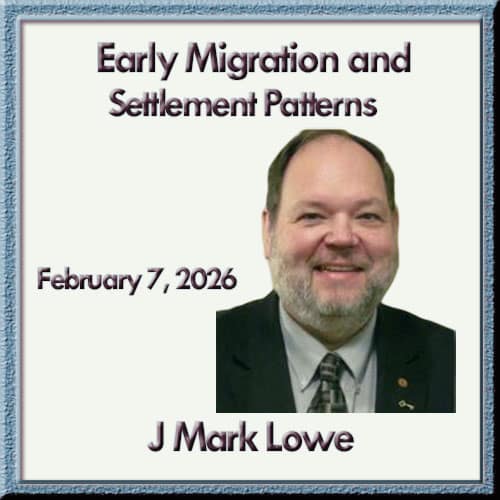
J Mark Lowe — Early Migration and Settlement Patterns
Presentation Description
Discover where a family moved into a state by using the statistical data recorded for all families. Learn to see where families were moving through the decades and use that knowledge to focus your research. Use the earliest records to find roads, communities, and potential neighbors, and develop a process for sweeping through the dust.
Meeting Summary
- Members Helping Members: Participants highlighted practical tools and strategies, including Goldie May for research logs, URL capture, migration trails, and mapping, plus a members-only NWSGS RootsTech tool that lets researchers search sessions, filter by topic, and even download the underlying spreadsheet for their own AI prompts.
- Research strategy over guesswork: J. Mark Lowe emphasized building migration theories from evidence such as agricultural patterns, business and industrial records, travel diaries, newspapers, military records, tax lists, land records, probate files, and court cases.
- Study the people around your ancestor: Neighbors, acquaintances, and “fictive kin” can be just as important as direct relatives when tracing where a family came from, moved through, or settled.
- Maps were a major theme: The presentation showed how historical maps can reveal boundaries, early roads, property ownership, trails, town structures, terrain, and the physical realities that shaped migration decisions.
- Migration often followed established routes: The handout adds strong member value by listing major trail systems and settlement routes, along with map collections and reference links that can help place ancestors on real movement corridors rather than treating migration as random.
- Land, probate, and court records can point backward: Deeds may name a prior residence, probate papers may mention relatives in another place, and chancery or equity cases can identify birthplaces, relationships, and associates who knew the family story.
- Do not overlook cluster evidence: County histories, church records, tax lists, census records, letters, and local documents can help reconstruct an ancestor’s community, especially when whole churches, kin groups, or neighborhoods moved together.
- Useful takeaway: The handout is more than a reading list. It provides a working roadmap of map collections, trail references, agricultural resources, and record types that researchers can use to turn a vague migration story into a focused research plan.
Why To Watch
This replay is worth your time if you have ever wondered why an ancestor moved, how they got there, or what records might reveal the path. J. Mark Lowe connects migration patterns to maps, land, probate, court, tax, and community records in a way that gives you a practical framework for your own research. The handout alone adds real value, with trail references, map resources, and record ideas you can use right away.
About the Presenter
He is a semi-retired professional genealogist, author, and teacher who researches primarily in original records and manuscripts throughout the South. He enjoys sharing what he has learned over the years through Webinars, YouTube, and Institutes. Mark has published articles in APGQ, North Carolina Genealogical Society Quarterly, SPEAK!, The Longhunter, Robertson County[Tenn.] Times. and other society publications.