
New to NWSGS? You're welcome at our meetings.
Everyone is welcome to register for NWSGS meetings. For added Zoom security, we ask each registrant to have either a free Guest account or a Paid membership on file before registering.
Our Free Guest account lets you register for meetings 14 days in advance.
Paid members receive additional benefits, including 30 day advanced registration, access to speaker handouts, video replays of meeting when permitted, members-only content on our website, ability to customize some email communications, and access to our newsletter, Notes from the Northwest.
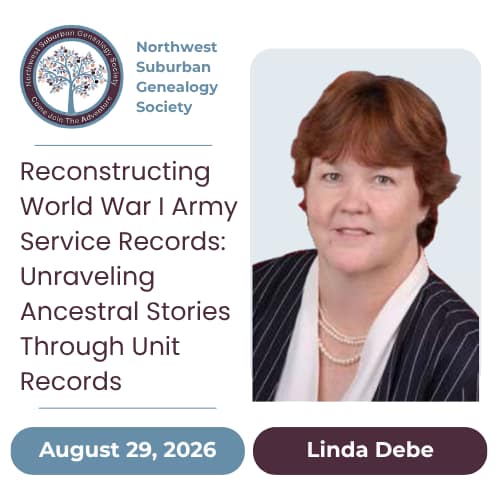
Linda Debe — Reconstructing World War I Army Service Records: Unraveling Ancestral Stories Through Unit Records
Presentation Description
In this one-hour presentation, we delve into the fascinating world of World War I army service records and explore the invaluable role of unit records in reconstructing the journeys of our ancestors who served. Discover how unit records provide a rich tapestry of information, offering insights into individual experiences, battles fought, and sacrifices made during this pivotal period in history.
By exploring the wealth of information contained within unit records, attendees will gain valuable insights into reconstructing World War I army service records and honoring the legacies of their military ancestors. This presentation aims to empower genealogists with the knowledge and tools needed to navigate the complexities of wartime research and preserve the stories of those who served.
Meeting Summary
Meeting Summary
Members Helping Members
- Be cautious when using AI for genealogy. One member shared how Google Gemini provided useful family-history information but later created an inaccurate military story about his father. AI can help generate research leads, but names, dates, relationships, military service, and other facts should always be verified with original or reliable records.
- Use the NWSGS Member Surname List to find possible research connections. Members can search for surnames or countries being researched by other society members and make contact when their family-history interests overlap.
- Preserve personal family materials. Letters, children’s artwork, handwritten notes, photographs, and similar items can become valuable family-history records because they preserve handwriting, personality, relationships, and everyday life.
- Consider donating important family collections. If family papers may not be preserved by future generations, genealogical societies, historical societies, college libraries, archives, and other repositories may be appropriate places to preserve them for future researchers.
Featured Presentation (Starting at about 55 minute mark)
Linda Debe presented a detailed look at researching World War I military service and using unit records to reconstruct an ancestor’s experience.
- Learn how the three World War I draft registrations differed and what information can be found on the various draft cards.
- Understand why identifying an ancestor’s military unit is one of the most important steps in World War I research.
- Discover how Veterans Master Index cards, headstone records, transport lists, muster rolls, morning reports, sick reports, and other military records can help reconstruct a veteran’s service.
- Learn how records found on FamilySearch and Fold3 can reveal service dates, units, transfers, illnesses, furloughs, next of kin, addresses, and other details.
- See why some military records must be searched by unit rather than by the veteran’s name, particularly morning reports and other unit-level records.
- Learn to read military abbreviations, remarks, column headings, and the backs of records, where important additional information may be recorded.
- See real examples of clerical errors and incorrect dates, reinforcing the importance of comparing multiple records rather than relying on a single document.
- Discover additional research possibilities through the National Personnel Records Center in St. Louis, VA records, manuscript collections, military unit histories, specialized websites, and organizations devoted to particular military units.
Why To Watch
Why Watch This Video?
If you have an ancestor who served during World War I, this presentation provides a practical roadmap for discovering much more than a draft registration card or basic service record can tell you.
Linda Debe demonstrates how to follow an ancestor through military records by first identifying the units in which he served and then using records such as transport lists, muster rolls, morning reports, sick reports, Veterans Master Index cards, and headstone records to reconstruct his military experience.
The presentation is especially valuable because it shows actual records and explains how to interpret abbreviations, remarks, dates, transfers, illnesses, and other clues. Linda also demonstrates why researchers should compare multiple sources, since even official military records can contain clerical mistakes.
The audience questions at the end add additional research ideas involving VA claims, military headstones, ranks, medals, and records that may not be easily searchable by name. Whether you are just beginning World War I research or have reached a dead end with an ancestor’s military service, this replay offers techniques and resources that may help you move your research forward.
About the Presenter
Linda Debe — Genealogy Expertise and Background
Linda Debe is a professional genealogist, lecturer, and family historian with over 40 years of research experience across the Midwest, as well as in several eastern and southern U.S. states. (progenstudygroups.com) She is affectionately known as “The Sleepless Genealogist”, a title reflecting her dedication to the craft. (thesleeplessgenealogist.com)
Professional Background
Experience: Specializes in U.S. records such as land records, Minnesota Native American records, wills, probate records, vital records, and census records progenstudygroups.com.
Research Methods: Skilled in both online research and in-person archival work at major repositories progenstudygroups.com.
Technology: Microsoft Office certified in Access and Excel, using spreadsheets to analyze large datasets efficiently. (FamilySearch)
Education: Holds an Associate of Science in Electronics Systems Technologies from the U.S. Air Force.