
New to NWSGS? You're welcome at our meetings.
Everyone is welcome to register for NWSGS meetings. For added Zoom security, we ask each registrant to have either a free Guest account or a Paid membership on file before registering.
Our Free Guest account lets you register for meetings 14 days in advance.
Paid members receive additional benefits, including 30 day advanced registration, access to speaker handouts, video replays of meeting when permitted, members-only content on our website, ability to customize some email communications, and access to our newsletter, Notes from the Northwest.
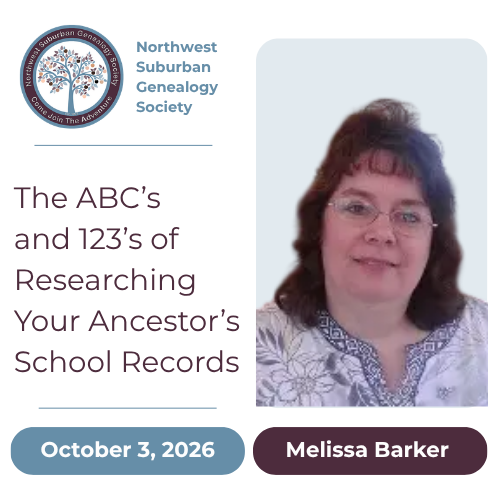
Melissa Barker — The ABC’s and 123’s of Researching Your Ancestor’s School Records
Presentation Description
The ABC’s and 123’s of Researching Your Ancestor’s School Records
The records of local public schools and universities can be valuable resources for finding information about your ancestors. Even if your ancestors didn't attend school, you would be surprised by what you can find in school records about them. This webinar will show you what types of school records there are and how to find them in repositories.
Meeting Summary
Meeting Summary
Melissa Barker
The ABC’s and 123’s of Researching Your Ancestor’s School Records
Melissa Barker demonstrates why school records deserve a place in every genealogist’s research plan. Using examples from archival collections and her own family research, she shows that these records can provide much more than grades.
Enrollment and registration records may include a student’s name, age or birth date, parents or guardians, home address, a parent’s occupation, and even the name and location of a previous school.
Attendance records can place an ancestor in a specific location at a specific time. Melissa explains that patterns of attendance or absence may also provide clues about farm work, employment, illness, deaths in the family, or other events that affected a child’s daily life.
She also explores report cards, school photographs, yearbooks, newspapers, college records, teacher contracts, and school board meeting minutes. These records can reveal the subjects an ancestor studied, academic achievement, clubs and activities, graduation information, teaching careers, and even details about the schools themselves.
One of the most memorable examples involves Melissa’s husband’s grandfather, who never attended school. Even so, she found him in school records because he had been paid to build cabinets for a school that his daughter later attended. The discovery created an unexpected connection between generations and illustrates why researchers should not dismiss a record collection simply because its title does not seem to fit their ancestor.
Melissa also emphasizes the importance of researching locally. Historical societies, libraries, archives, school districts, courthouse collections, manuscript collections, and local newspapers may all hold school records that have never been digitized. Her advice is simple but valuable: when researching a new area, keep asking, “Where are the records?”
For researchers who cannot travel to the area where their ancestors lived, Melissa offers encouragement as well. She has conducted successful long-distance genealogy research for decades and stresses that patience, email, and communication with local repositories can still produce excellent results.
Why To Watch
Why You Should Watch
This meeting offers practical ideas you can put to work in your own genealogy research. Members Helping Members includes useful discussion about British military records, changing geographic boundaries, Lithuanian research, RootsTech, and other research resources.
Melissa Barker’s presentation then takes a close look at an often-overlooked source: school records. She shows how enrollment records, attendance books, report cards, yearbooks, photographs, newspapers, teacher records, and school board minutes can reveal details about an ancestor’s childhood, family, education, and community.
About the Presenter
Melissa Barker, known as The Archive Lady, is a Certified Archives Manager, Public Historian, and professional genealogist specializing in Tennessee records.
Melissa Barker has been a professional genealogist for over two decades, with extensive experience in researching family histories and archival records, particularly in Tennessee and Kentucky. She currently serves as the Archivist and Records Manager at the Houston County, Tennessee Archives & Museum, where she has been the first and only archivist for more than 15 years. Her expertise includes historical records methodology, records preservation, and genealogical research techniques.
Contributions to Genealogy
Melissa is widely recognized in the genealogy community for her educational efforts. She conducts virtual webinars and presentations across the United States and internationally, teaching genealogists how to navigate archives, locate historical records, and preserve documents. She has presented at conferences such as the We Are Cousins Virtual Genealogy Conference, covering topics like “Breathing New Life Into Your Boring Ancestors” and using finding aids for manuscript collections.